David Harrison Horton on His New Poetry Collection "Necessary"
I always say that the key to Beijing is finding your own community. For all I care, it could be the local chapter of ant farmers. Community will give your life here some much-needed structure and sense of belonging. Mine, you ask? Can't say I've ever regretted tagging along with the literary crowd in Beijing. It's afforded me the absolute privilege of knowing people such as David Harrison Horton. Horton, a transplant from Detroit, Michigan, first came to China in the early aughts, brandishing a MFA in Poetry from Mills College (Oakland, CA), and he has stayed put in Beijing, where you can often see him performing at Spittoon Poetry Night, provided he's not busy writing new poems or editing his zine Saginaw, which he gifts to anyone wanting a copy.

He's a quiet yet remarkable man, always with a kind disposition, which you will notice if you attend the event, Beijing Poets at The Hutong this Saturday (Sep 13) from 4pm to 5.30pm. Tickets are RMB 50, money well spent considering Horton will be sharing the stage with fellow bards Feniá G. and Anthony Tao. May they both forgive me for focusing on Horton this time, on the occasion of his new poetry collection, Necessary. I haven't finished the book yet because would you down your finest bottle of wine in a few rushed gulps?
Poetry sometimes has a bad rap: inaccessible, cryptic, hard to understand. So far, I can say that Horton's Necessary certainly won't present you with clear stories and easy symbols. But it will be an invitation to submerge yourself in some tempestuous and sharp poetry. In this new book, Horton wields poetry with assertiveness and an exquisite command of language. No superfluous words, no fluff. There's an exploration of time, place and connection, spanning across multiple moments in time and history to thread a superbly layered meditation on our understanding of the places we occupy within “inherited and unfolding narratives.”

American poet, critic and author Stephen Ratcliffe has described Necessary as “indeed necessary reading for anyone who wants to know what's really going on in China these days.” As for myself, I would rather sit the poet down and have him chat with us all. Dear reader, join me for this one, and be sure to have a seat this Saturday at The Hutong. I promise you couldn't have a better Saturday plan if you tried.
Hello, David. I hope folks snag every last copy of Necessary out of your hands this Saturday. My impression is that you generally opt for a free-spirited approach to understanding literature, and by extension, poetry. Meaning, we do not necessarily need grandiose academic words to describe what we read, but rather just to sit down with a text and let it resonate with us. How would you say that works?
I like to think that I hold an open approach to how I understand the process of reading and meaning creation. We all come to a text with different backgrounds, experiences and perspectives. What I make of a text will have meaning for me, and very likely it'll differ, maybe greatly, from how anybody else will approach and create meaning from the text for themselves. Now we have things we can discuss and mull over. There isn't one correct way to read a text, especially literature. That's part of the fun of it for me.
One of the driving ideas I had while working on Necessary was the notion of palimpsest, where writing occurs over top of older writing, but sometimes the original text comes through. So, we find snippets of text and sources interspersed with a more contemporary narrative. For example, there is mention of the Babylonian goddess Tiamat, which I got from reading poet Elizabeth Willis, who got it from somewhere, on down the line until you get to the ancient original. How can we find meaning in its current iteration in our current circumstances? There are several strategies. We can look at Tiamat as an image in a collage and see how it functions with what is next to it now. We can take things that seem oddly juxtaposed and decide how these work, or don't, next to each other. There isn't a single correct approach, so I suggest trying to have fun with it. It might mean spending more or less time on a set of lines as you work your way through it, and that's perfectly fine.

Fine advice for readers, so may we now address the poet? Your poetry in Necessary is refined, pared down to the essentials. As a writer myself, I always fear unnecessary verbiage. Would you extend an advisory, please?
In her blurb for the book, poet Elizabeth Robinson called me “a writer of some restraint.” I was initially surprised by that, but I understand how that applies to this book. I started writing Necessary when I first came to China. Over the course of two decades, I have revisited it multiple times and worked on getting the language down to what I considered essential – essential for flow, for effect, for meaning. I also tried to get each nine-line segment to also be in conversation with the other parts of the book, so that even though each part was a compact unit, each compounded the effect and meaning of the others and the whole, forming a shadow of narrative and mood.
A timely reminder that literary creation needs time. Speaking of China, of Beijing, what trace has it left in your poetry?
China certainly factors into Necessary's material sources. Remnants of my reading of The Travels of Marco Polo show up earlier in the text; images from walks through the hutongs and other observations hopefully show just how many layers of previous stories there are for places like Beijing. For every neighborhood here, there's a piece of history, a story to unfold. Some of what Marco saw, we can still see today. How does that connect to the women in the hutongs going about their morning vegetable shopping today? How do we place ourselves in these contexts?
Beijing generally factors quite heavily in my body of work. Altogether, I've lived in China for about 20 years, with 16 or 17 of those being in Beijing. So of course, Beijing will luckily show up and through my writing. It is an extraordinarily interesting place, if only you can manage to slow down enough to actually look around and take in the smallest of daily details.

Stop and smell the flowers. Lucky attendees to The Hutong this Saturday will find you sharing the spotlight with Anthony Tao and Feniá G., two outstanding poets and fellow members of our literary community. I think we share an ardent appreciation for our mutual circles, where strong ties form easily and lead to beautiful, magical projects and initiatives.
Absolutely. With the disclaimer that there are many such poetry circles in Beijing, I am connected most with the Spittoon Collective, hosting four different English-language events for the first four Thursdays of every month (presently at Zarah). I first became involved with Spittoon during Covid times, and immediately felt this writerly communion. In addition to the readings, I would sometimes attend Spittoon's workshops, then led by Michael Burton and Abigail Weathers, who are both great poets.
My acquaintance with Anthony Tao, the Poetry Night host, actually predates Spittoon, but I did meet Feniá G. through the group, along with plenty of others. I've been part of other poetry scenes (mostly SF Bay Area and, briefly, New York) where I observed politics and active jockeying for this notion that one should win at some jarring contest of poetry. Spittoon is remarkably different on that front. There is an openness to it; everyone is doing their own thing, and everyone's supported in the pursuit of it. So there's a lot of room to try new things out. Success, whether your own or others', is something genuinely celebrated here.

Indeed! Let's close on a strong question. Does the poet have a duty in these strange times? If so, what is it?
Duty is such a loaded and heavy word. I like to think poets can be of service, and there are many ways they can do that. Anthony Tao's book We Met in Beijing, among other things, is a poetry of witness, and that is certainly a service. Feniá G.'s Spout is a poetry memoir filled with uplift and courage. Somewhere in Fangshan, Kansas – wherever – a little-known poet is posting something on her socials that might inspire one of her followers to ponder something differently, if even briefly. That is also a service to that one reader. So, yeah, I think there are many roles for poets and poetry (and the arts in general) in contemporary society.
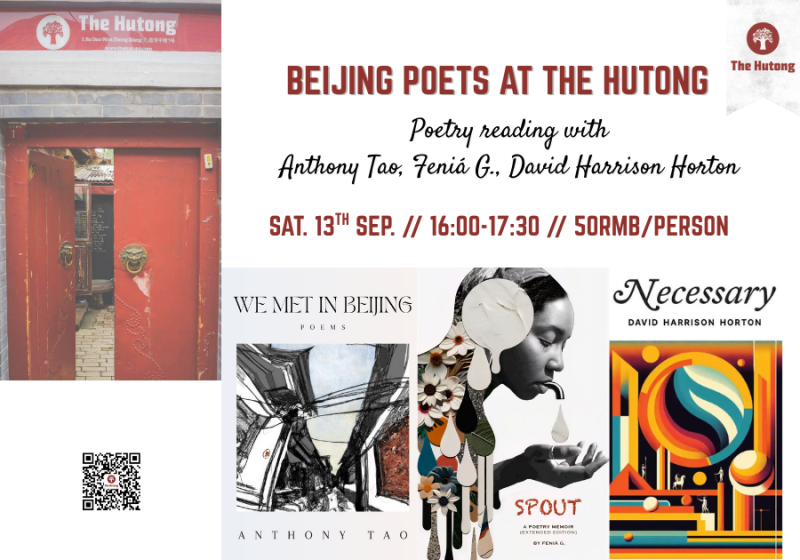
Beijing Poets at The Hutong is happening on Sat, Sep 13, from 4pm to 5.30pm at The Hutong. Entry is RMB 50/person. Necessary, along with We Met in Beijing and Spout will also be available for purchase at the event.
The Hutong
1 Jiudaowan Zhongxiang Hutong, Dongcheng District
东城区九道弯中巷胡同1号
READ: Podcast Alert: Talking Women in Music With MusicDish
Images courtesy of: David Harrison Horton, The Hutong