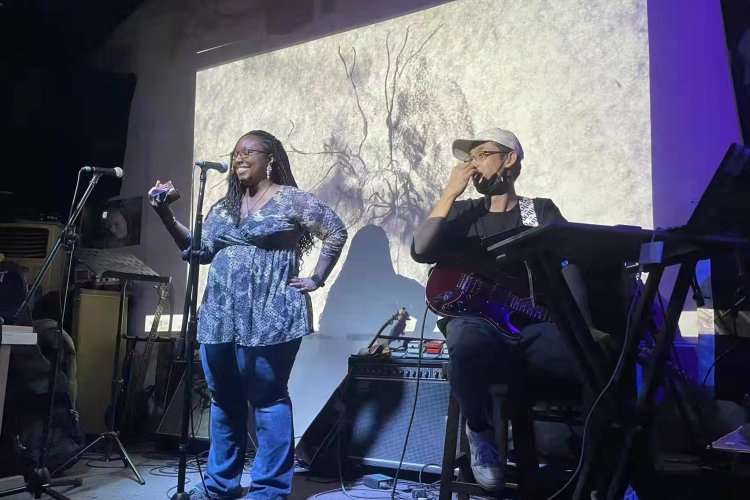
Less is More: An Interview with Nik Bärtsch
Both Zurich and Berlin are cradles of inspiration, so living between the two cities gives Swiss pianist and composer Nik Bärtsch the benefits of both. Besides his solo career, he’s also known for being the frontman of neo-jazz band (or what he prefers to call “zen-funk”) Ronin and multi-media acoustic ensemble Mobile.
Now Beijing has the chance to see Ronin perform this Thursday night, November 12 at Yugong Yishan. We talked to the zen funk master about how Ronin makes jazz funky and how he transforms his philosophy into a live stage experience.
the Beijinger: What got you into jazz in the first place?
Nik Bärtsch: As a small child I was moved by rhythms and often played with my hands or a fork or whatever was on the table – so it was normal that I wanted to learn drums at the age of about seven. My mother had to find a private teacher since drums was not an official instrument for a little child. A bit later I heard another child playing Boogie Woogie on a piano and I told my mother that I wanted to play piano too, but not Beethoven’s ‘pour Elise’ or something like that but Blues and Boogie Woogie. So again she had to find a private teacher since there was no one from the official public school who had an idea. This teacher introduced me to serious improvisation, blues and jazz and my serious interest in classical music came about eight years later, from studies in Bartoks Mikrokosmos, also a very dynamic rhythmic music!
tbj: How did Ronin come together?
NB: It is a long story. Ronin drummer Kaspar Rast and I met as kids. We started to play soccer and music together at the same time. Since then we have played together. Also percussionist Andi Pupato is from our neighborhood and we played together as teenagers. We met bass player Björn Meyer about twelve years ago when he came to Switzerland from Sweden. Kaspar heard him in a jam and we started to play. This was a time when we wanted to play again more in clubs because I played only acoustic in a radical phase in long music rituals with our other group Mobile. First Ronin was a Trio, then Andi joined for the first record because we wanted to have subtle energy changes with shakers and some added percussion for our work with musical patterns. Reeds player Sha is a bit younger then the rest of the band and was initially a special guest. He was very talented and dedicated to our music and when we started our Mondays concert series in autumn 2004 at our own club, he was there every Monday. So it was clear that he would join for the first record we recorded for ECM.
You see that the social aspect is also very important for our band. Ronin is a whole organism with strong individual members.
tbj: It seems like many of Ronin’s songs have titles like “Modul XX” instead of “proper song titles.” Why is that?
NB: To choose titles for aesthetic phenomenas like bands, concepts, styles or pieces needs a consciousness for the pictures, contexts and poetic values that you create. We as a band and I as a composer work with modular musical tactics and strategies. On the other hand we don’t want to tell the listener what pictures or thoughts he or she should have when they are listening to a musical piece. Everybody sees and feels different. We would like to leave the poetic freedom of the title to the listener.
When a modular pattern combination makes sense dramaturgically and in its coherence, I give this composition a number. The rest is an open poetic space.
tbj: Can you briefly explain your own definition of minimalism?
NB: Minimalism is a dangerous term. I prefer to use terms and concepts like ‘reduction,’ ‘ritual,’ ‘less is more.’ I have no definition for Minimalism in general. There is a historic understanding of musical minimalism created by the critic: the American minimalism which was developed in the 50s of the last century by composers like Reich, Glass, Riley etc. But already there the term is used as an undifferentiated summary for several musical strategies and phenomenas. I am more interested in single pieces of composers and not in a categorization of a whole style. But of course it is ok for the critic and musicologists to name and categorize certain streams of art surfaces.
tbj: Do you believe creativity can be better expressed through improvisation or rational controls?
NB: I am not able to divide our consciousness and awareness in ‘rational’ and/or ‘intuitive’. I understand our mind and body as a complex combination of several processes of awareness. ‘Creativity’ is a mystical term. What is it exactly? You can find it everywhere, in improvisation, interpretation and composition. We are interested in this triangle: composition, improvisation, interpretation; and in its combinations or transformations. We use improvisation more in a modular sense. You often cannot say anymore as a listener if our music is improvised, interpreted or a strictly played composition. For me improvisation is the ability to outfox yourself creatively. So it has also to do with humor, irony and modesty.
tbj: By borrowing from heavy bass and techno beats, funk is strongly blended into Ronin’s music, what are the funk musicians/bands have influenced you?
NB: We are influenced by subtle beats, grooves and patterns. It doesn’t matter from what style. Techno is not really an influence, but maybe the idea of ‘drum and bass’: it is interesting to listen to a rhythm section without the disturbance of too much narrative melody. But you can find this idea in earlier styles: in famous jazz rhythm sections, in some parts of Stravinsky’s music, in traditional ritual music. It is the idea that rhythms and their combination can take over the dramaturgical function of the melody and harmony. But you are of course right: we love funk bands like The Meters, the Neville Brothers, James Brown’s bands, Prince - especially the rhythm section with Michael B and Sonny T etc.
tbj: In what specific ways have you been integrating the idea of Zen into Ronin?
NB: I used the combination of the words Funk and Zen. ‘Zen’ is a term with a long history and tradition. I am interested in Zen as a philosophy of life and especially in its idea of practicing the philosophy every day and also in a group. Ronin as a band does not practicing Zen in a traditional or religious way but to play our music you need the combination of tension and calmness, of highly developed handcraft and technique. It needs a paradoxical consciousness and probably lifelong practicing. For me Zen is a helpful practical philosophy, even if it has a strong history and background of strategies of thinking and finding words for the phenomena in life. The European alternative for this philosophy is the old Greek Stoa school (that’s also why I have chosen ‘Stoa’ as a title for our first ECM record). Combined with funk it creates a paradox tension: emptiness and silence versus power of the groove, meditation versus rhythm rituals. I don’t know why but I need both energies to survive and maybe these two ‘philosophies’ have more in common than we think: discipline, percussive roughness, less is more, doing nothing at the right spot… Even if the single members of the Ronin band are far from being enlightened, the whole band as an organism maybe is – at least through our light technician…
tbj: Apart from being the Ronin frontman, you are also a member of the acoustic Mobile. How did that started and what are the main difference between Mobile and your other projects?
NB: Mobile is acoustic and plays only in long music rituals in a multi media set up. For example we played a six-hour ritual at a stage in the lake of Zurich on a modular light floor. So a Mobile ‘concert’ needs more preparation and time. Mobile was my first project in a phase where I was very radical and where we wanted to experience again the very fundamental and pure energies of music – without amplification, without breaks and with a close strong group spirit: radical but open offer for the public to join us. The first project was the Blue Trilogy, which included three concerts (every year one concert) of 36 hours of live music combined with other arts like light, video, Iaido (the art of the sword) and architecture.
Ronin is a more flexible amplified band for festivals, clubs and travels, but it has developed into our main project now.
tbj: You lived in Japan for a while, how has that experience influenced your creative mind?
NB: This is a very difficult question for me. I am not sure myself whether my stay has created direct influences, fruitful misunderstandings, inspiration, or general changes of my view of ‘life.’ What I can say is that it inspired me very much energetically. And I could see my own country and culture from a far distance for a few months, which is always very fruitful!
tbj: Have you been to China before?
NB: I never had the chance to come to China before. Unfortunately we are only a very short time in China and cannot really enjoy its whole variety and complexity. But to travel and present our music is our life and we are very happy to have the possibility to communicate the first time with an audience here. When you can show what you love to do most yourself, normally this contact is very real and honest and you learn a lot also about your partner. That’s anyway what I am interested the most: learning.
tbj: Have you collaborate with any Chinese musicians before?
NB: No, unfortunately not, but through our producer Michael Vonplon, we got in touch with many Chinese artists who now travel to Switzerland. We recently had a band in our club in Zurich. The Chinese pipa player Jing Yang lives near Zurich and she visited our club several times.
tbj: Which musician do you mostly want to work with? Why?
NB: With my friends with whom I already play. Our teamwork is a creative strategy to develop our aesthetics and learn more about the musical possibilities of a group and us. We believe in teamwork on the base of individual choice and freedom. This is the Ronin spirit.
tbj: Do you believe in God or Buddha?
NB: I unfortunately did not have the chance to meet Buddha or Jesus so I can only talk about them from a far historical perspective. So it makes no sense to believe in one of them even if they probably were very strong and inspired personalities. ‘God’ is just a word. It means everything and nothing. It makes no sense as a term. I call myself a spiritual person. But music is my channel to express this. I believe in music. And I like the Greek philosopher Socrates. He said ‘I know that I don’t know anything – but I know a lot about this ‘not-knowing’. Isn’t that funny paradox?
Nik Bärtsch perform with his jazz ensemble Ronin at Yugong Yishan on November 12. RMB 50. 9pm. 3-2 Zhangzizhong Lu (100m west of Zhangzizhong Lu subway station), Dongcheng District (6404 2711). 东城区平安大道张自忠路3-2号(地铁五号线张自忠路站往西100米)